
Is Your London Property Costing You Money?
Most landlords who self-manage believe they're saving money. When you add up the real numbers, the picture often looks very different.
Self-managing a rental property has always had an obvious appeal: no management fees, full control, and the satisfaction of knowing exactly what's happening with your investment. For many landlords, it works — at least on the surface.
But the lettings landscape in 2026 has changed substantially. Compliance obligations have grown, legislation has tightened, and the true cost of managing a London rental yourself is higher than most people realise. Here's what the numbers actually look like.
The costs landlords forget to count
Most landlords calculate their return by subtracting their mortgage payment from the monthly rent. That's a starting point — but it misses a significant number of real, recurring costs that quietly eat into yield every year.
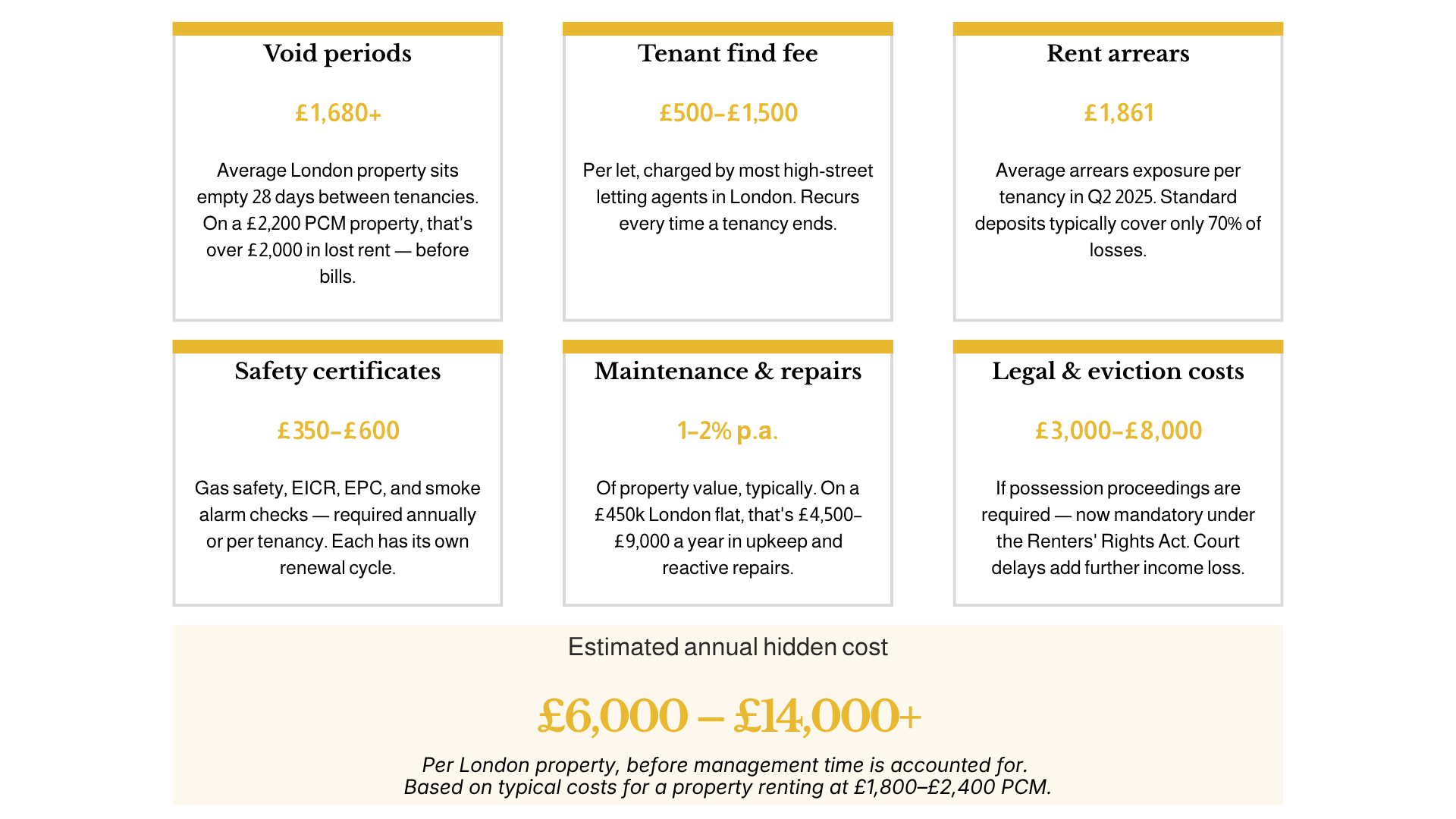
The cost no one talks about: your time
Managing a property isn't just collecting rent and calling a plumber. In 2026, the administrative load of self-management includes tenant sourcing, referencing, check-ins and check-outs, deposit disputes, maintenance coordination, compliance certificate renewals, rent reviews, and keeping pace with rapidly changing legislation.
Most self-managing landlords spend several hours per week on these tasks — time that rarely features in any return-on-investment calculation. For landlords who are employed, running a business, or based outside London, that time has a real opportunity cost.

What the Renters' Rights Act adds to the equation
From 1 May 2026, the Renters' Rights Act fundamentally changes the risk profile of self-management. Section 21 no-fault evictions are abolished. All tenancies become rolling periodic — meaning tenants can leave with two months' notice at any time, making void periods harder than ever to avoid. The arrears threshold before you can apply for possession rises to three months, and every possession action now requires a court hearing.
For self-managing landlords, this means longer exposure to problem tenancies, higher legal costs, and greater income uncertainty — all without the buffer of a professional management structure.
A simple self-audit
Before deciding whether self-management is still working for your property, it's worth asking yourself:
Have I tracked every cost — void periods, repairs, certificates, admin time — against my rental income in the last 12 months?
Do I have up-to-date Gas Safety, EICR, and EPC certificates in place — and do I know when each expires?
Am I confident I understand the Renters’ Rights Act changes and how they affect my current tenancy?
If my tenant stopped paying rent tomorrow, do I know exactly what steps to take and how long it would take to resolve?
Is the time I spend managing this property the best use of my time — or would a fixed, guaranteed income with zero management responsibilities serve me better?
What the alternative looks like
A guaranteed rent arrangement doesn't mean sacrificing income for convenience. When you factor in void periods, maintenance costs, compliance fees, tenant-find charges, and the growing risk of legal proceedings, a fixed monthly payment — guaranteed regardless of occupancy — often represents a stronger net return than the headline rent on a self-managed property.
Under a Paréya Properties management agreement, you receive a fixed rent every month for 2 to 5 years. We handle everything: tenant sourcing and management, maintenance, and all day-to-day administration. Where needed, we also carry out a complimentary cosmetic refurbishment before the tenancy begins — at no cost to you.
There are no management fees, no letting agent charges, and no deductions for voids. Just a single payment into your account each month, every month.
