
Guaranteed Rent vs Traditional Letting: The True Cost Comparison for London Landlords in 2026
The headline rent on a traditional letting often looks better on paper. But when you run the full numbers — voids, arrears, fees, compliance, and legal risk — the picture changes significantly.
Most London landlords assess their return by looking at one number: the monthly rent. That's understandable — it's the most visible figure. But it's also an incomplete picture. The true yield from a rental property only emerges when you subtract every cost that sits between gross rent and what actually lands in your bank account.
In 2026, with the Renters' Rights Act reshaping how tenancies work, that calculation has become more complex — and more consequential — than ever. This article runs the real numbers side by side so you can make an informed decision.
The three-year cost breakdown

Based on worked example above. This conservative comparison includes only the costs directly attributable to the letting model — agent fees, void loss, carrying costs, and landlord time. Results vary by property, location, and individual circumstances.
Why the numbers look like this
Even with a conservative scenario — one void month in three years, modest time commitment — the gap is meaningful. Two factors do most of the work:
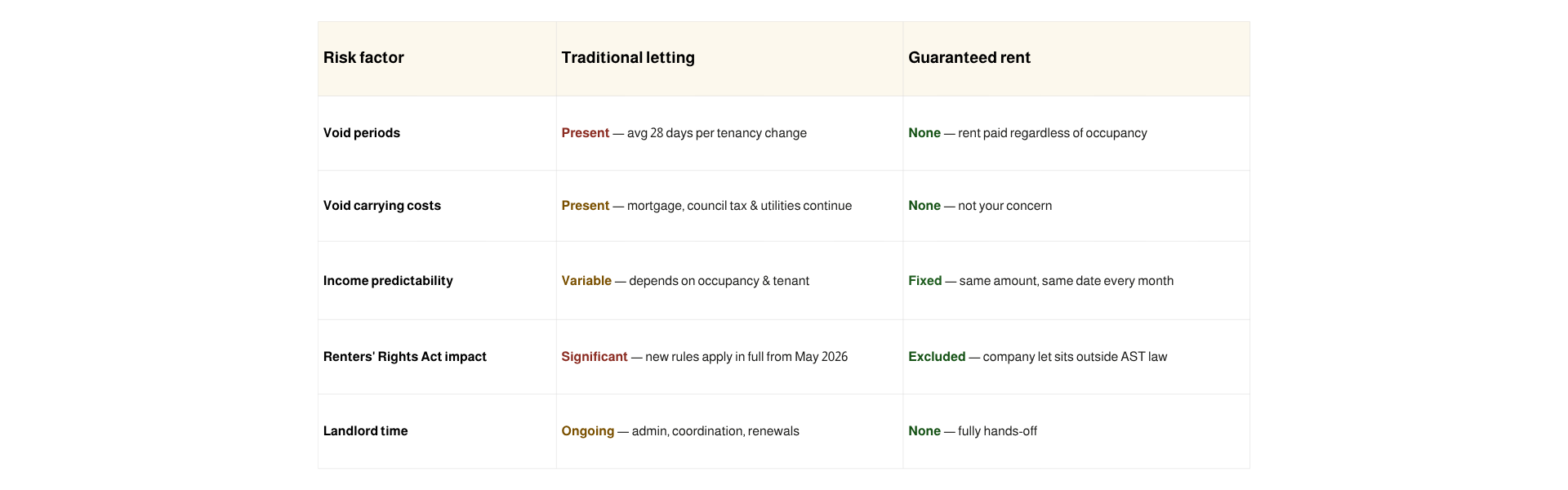
Void periods — and what they actually cost. Losing a month's rent is the obvious hit. But the void period carries a second, less visible cost: your outgoings don't stop. Mortgage interest continues. Council tax falls to you as the landlord once the property is empty — at the full rate in most London boroughs after any short exemption period. Utility standing charges accrue. On a typical London two-bedroom flat, these carrying costs add £600–£800 to every month the property sits empty, on top of the lost rent itself. Under the Renters' Rights Act's new periodic tenancy model, voids are expected to become harder to avoid, as tenants can give two months' notice at any point without a fixed term to anchor them.
Agent fees and landlord time A 12% letting agent fee on a £2,000 PCM property costs £8,400 over three years — before any additional charges for tenant find, renewals, or administration. Even at just one hour per week of personal management time, valued conservatively at £20 per hour, that's a further £3,120 over the same period. Time spent chasing contractors, responding to tenant queries, and staying on top of renewal deadlines is rarely factored into a landlord's yield calculation — but it has a real cost.

Risk comparison at a glance
When traditional letting still makes sense
The numbers tell one story — but context matters. Traditional letting can still work well for landlords who are experienced and hands-on, have a stable long-term tenant already in place, and are operating in an area with very low void rates and strong tenant demand. If agent fees are avoided through self-management and voids are minimal, the gap narrows considerably.
But in 2026, with the Renters' Rights Act increasing income unpredictability — particularly around void periods, as tenants on periodic tenancies can give notice at any point — fewer landlords are finding those conditions hold consistently over a multi-year period.
What guaranteed rent looks like in practice
Under a Paréya Properties management agreement, the arrangement is straightforward. We sign a fixed lease with you for 2 to 5 years, pay you a guaranteed monthly rent on the same date every month — whether the property is occupied or not — and manage all tenant-facing operations in between. Tenant sourcing, maintenance coordination, inspections, and day-to-day administration sit entirely with us. Compliance obligations such as safety certificates remain the landlord's legal responsibility, as they do under any letting arrangement.
Where your property needs freshening up before the tenancy begins, we carry out a complimentary cosmetic refurbishment at no cost to you. And at the end of the term, the property is returned in agreed condition.
There are no management fees, no letting agent charges, and no deductions of any kind. Just a single fixed payment into your account each month.
